In the beginning, there was Aino Ackté
A debut concert at sixteen, a glittering career in Paris, London and New York, the founding of an opera house in Helsinki, the launch of an opera festival in Savonlinna, the writing of the libretto for Juha. It is hard to imagine the history of Finnish opera without Aino Ackté.
Aino Ackté’s parents, Emmy and Lorenz Achté, were both singers. The couple had been involved with the Finnish Opera, which began its short-lived existence in 1873, but their most significant contribution to opera was arguably bringing their daughter Aino into the world on 23 April 1876.
Helsinki soon proved too small a stage for Aino Ackté’s talent and ambition. She left to study in Paris as early as 1894, and within just three years she was enchanting audiences at the Paris Opera as Marguerite in Faust. The Metropolitan Opera in New York followed six years later, and in 1910 Ackté took London’s opera world by storm in the title role of Richard Strauss’s Salome. She knew how to advance her career, and went so far as to call on the composer in person. “It might have helped if he had fallen in love with me, but Strauss did not fall in love at all, despite the considerable skill and discretion of my flirtation,” Ackté recalled with her characteristic candour.
The Birth of a National Opera
Aino Ackté wanted to perform her great roles at home, too. There was, however, one minor obstacle: Helsinki did not have an opera house. Ackté proposed founding one to the businessman Edvard Fazer, who doubted whether enough people with the right skills could be found for the venture. ”All it takes is two people. You handle the financial side as one director, and I handle the artistic side as the other,” Ackté replied. With those words, the Domestic Opera was born.
Creating an opera from nothing was no easy task: there was no venue, no orchestra, no singers, no audience, no money and no experience. The standards demanded by an international star were not achieved immediately. Wäinö Sola recalled how Aino Ackté began calling ”an unfortunate soprano some rather unpleasant names” during rehearsals, resulting in “a fit of tears and nerves with disagreeable consequences.” When Sola dared to point out to Ackté her “lack of goodwill towards a colleague,” everyone naturally got a piece of her mind.
After just one season, Aino Ackté left. She claimed publicly that she had been schemed out of the opera. The opera people, for their part, responded that Ackté’s own ”unrestrained and offensive conduct had forced the orchestra, chorus and artists to threaten to walk out.” Ackté countered that it was her duty to speak up when ”the chorus sang out of tune and out of time” and ”certain instruments came in at the wrong moment or stayed silent altogether.” The opera had been running for only a year, and the infighting was already fierce. Quite like in any civilised nation, in fact.
The artistic director departed, but the opera survived. Helsinki now had all the national cultural institutions it needed, making Finland ripe for independence in yet another respect. Aino Ackté had already achieved more than she could have imagined.
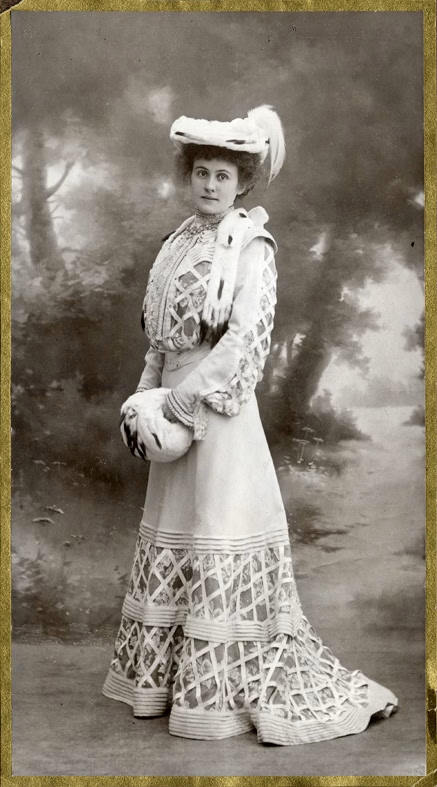
The lasting legacy of a celebrated diva
Founding one opera was never going to be enough for such an energetic and determined woman. She conceived the idea that Olavinlinna Castle would be a magnificent setting for opera productions, and so Erkki Melartin’s Aino was performed within its walls in 1912. Finnish operas were staged there for five years, after which the festival lay dormant for several decades. Aino Ackté, however, had no shortage of things to do. She sang in La traviata at the Swedish Theatre in Helsinki while her sister Irma Tervani performed the role of Carmen at the small opera house on Bulevardi.
Gradually, past quarrels were forgotten, and Aino Ackté returned once more to the stage of the Finnish Opera. Her farewell performance on 7 February 1920 was Tosca, one of Ackté’s most celebrated roles. According to the national newspaper Helsingin Sanomat, the evening was “one of the most brilliant occasions our opera has ever seen.” Aino Ackté experienced once more what it meant to be a celebrated diva: “the curtain calls were countless and the flowers abundant.”
In 1938, Aino Ackté’s skill and energy were called upon again, and she was appointed director of the Finnish Opera. “I have taken on an unbelievable endeavour,” she wrote to her husband, not entirely without reason. The familiar problems surfaced once more, as finances were exhausted and standards still fell short. Attitudes were also an issue. Wäinö Sola felt that her appointment had overlooked the character Eenokki’s warning in Aleksis Kivi’s play Betrothal: ”A woman’s rule is a sign of sorrow, foretelling the ruin of nations.”
The performances still failed to reach the level Ackté sought. “Dreadful, outrageous, appalling,” she declared. “Premieres can no longer be contemplated without foreign guest artists,” she announced, infuriating the Finnish singers.
“She is ’most dreadfully’ enthusiastic and torments everyone endlessly. The artists fear rather than respect her,” Wäinö Sola recalled. Ackté had her hand in everything, from direction to conducting the orchestra. She did have good reason to: she knew what opera at the highest level should look like. The resources needed were simply not there, and so the tenure of Finland’s first female opera director lasted just one year.
What if Aino Ackté had never been born? The establishment of a permanent opera in Finland could have been delayed by years, as the Alexander Theatre, which transferred to state ownership in 1918, might never have become an opera house. The Ostrobothnians, often called Finland’s national opera, might never have been composed, the great opera boom of the 1970s might never have happened; and the new opera house might never have been built. Aino Ackté’s time on earth came to an end on 8 August 1944, but her influence lives on every day at the Finnish National Opera and in Savonlinna.
Text by Juhani Koivisto
Translation by Anna Kurkijärvi-Willans
The main image of the article shows role portraits of Aino Ackté as Salome in London, apparently in 1910. Photo: The Dover Street Studios, London.
Finnish National Opera celebrates Aino Ackté in spring 2026 with Luonnotar and Iolanta. It is in the repertoire from 15 May to 30 May 2026.