Shakespeare’s greatest tragedy
Hamlet marks the beginning of a darker turn in Shakespeare’s oeuvre.
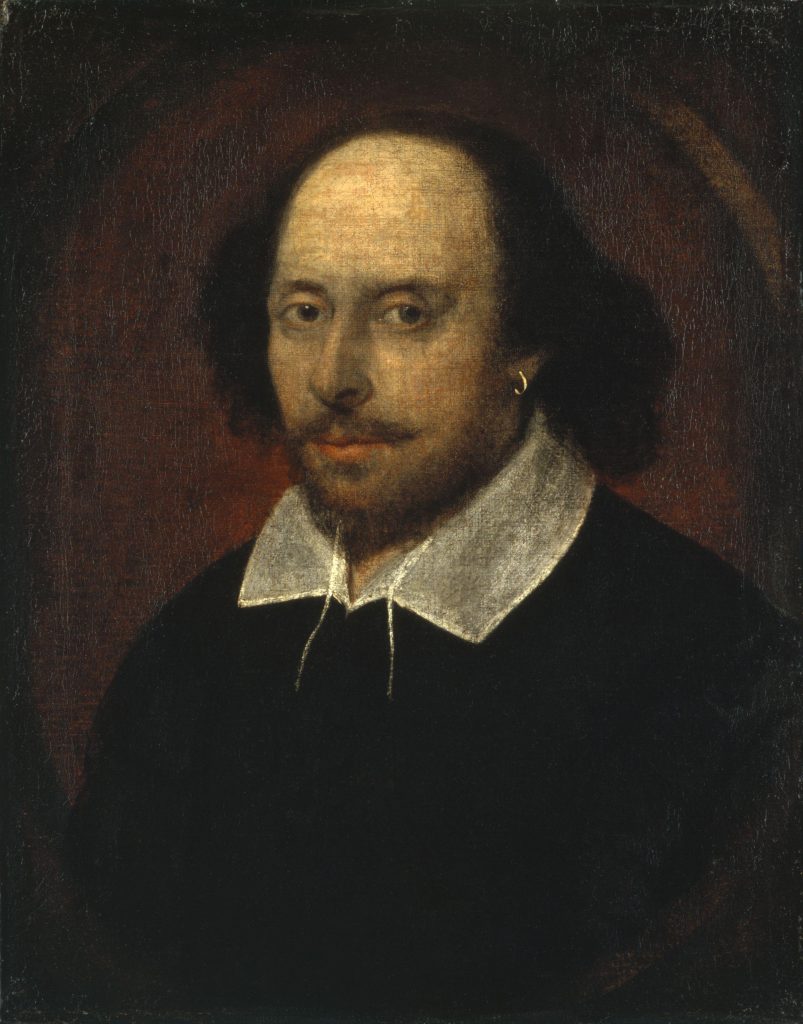
When William Shakespeare (1564–1616) began working on what many consider his greatest tragedy in the late 1590s, he was in his mid-30s. While he had written a few tragedies – Titus Andronicus (1592), Romeo and Juliet (1595) and probably also Julius Caesar (1599) – he had primarily been writing histories and comedies, and had just finished Henry V and As You Like It (both around 1599).
Picture: Wikimedia Commons
Hamlet (1599–1601) marks the beginning of a darker turn in Shakespeare’s oeuvre, the period of the great tragedies, Othello (1603–04), King Lear (1605–06), and Macbeth (1606), along with the so-called “problem” comedies, Measure for Measure (1603–04) and All’s Well That Ends Well (1604–05). There has been much speculation about why the tone of Shakespeare’s plays changes so much around the turn of the century. There may have been personal reasons: Shakespeare’s son Hamnet died in 1596, and his father would die in 1601, most likely after Hamlet was completed. There may also have been a political dimension: the long reign of Queen Elizabeth I was drawing to a close and there was uncertainty over who would succeed her to the throne. Some have even speculated that the Fortinbras plot, where the Norwegian son of a former enemy succeeds to the Danish throne, supports the claim of James VI of Scotland, son of Elizabeth I’s enemy Mary Queen of Scots, to the English throne.
Shakespeare’s main source is a lost play known as Ur-Hamlet (c. 1588), possibly by Thomas Kyd, derived from François Belleforest’s Histoires Traqiques (1580), a retelling of a 12th century Latin work by Saxo Grammaticus. In Saxo, a Danish nobleman Amleth (“dim-witted”) takes revenge after his uncle kills his father and marries his mother. Belleforest emphasizes the contrast between the good king and his evil brother, a theme Shakespeare develops at length. Shakespeare seems also to have been inspired by Kyd’s The Spanish Tragedy (1588–89), taking such elements as a protagonist who berates himself for being unable to act, a play-within-a-play, as well as a female character who goes insane and commits suicide.
Exploration of the inner life
The central conflict of the play is between Hamlet and his conscience, as he weighs the conflicting demands of filial duty and the Christian injunction against murder. Is a son morally bound to revenge his father’s murder, or a loyal subject his king’s? Revenge tragedy was a popular genre in early modern England, and Hamlet is one of many similar plays, each more gruesome in its revenge than the previous. Hamlet’s “thinking too precisely on the event” is contrasted with the behavior of two other sons, Laertes who storms the Danish court to avenge his father’s murder, and Fortinbras who raises an army to reverse his father’s military defeat.
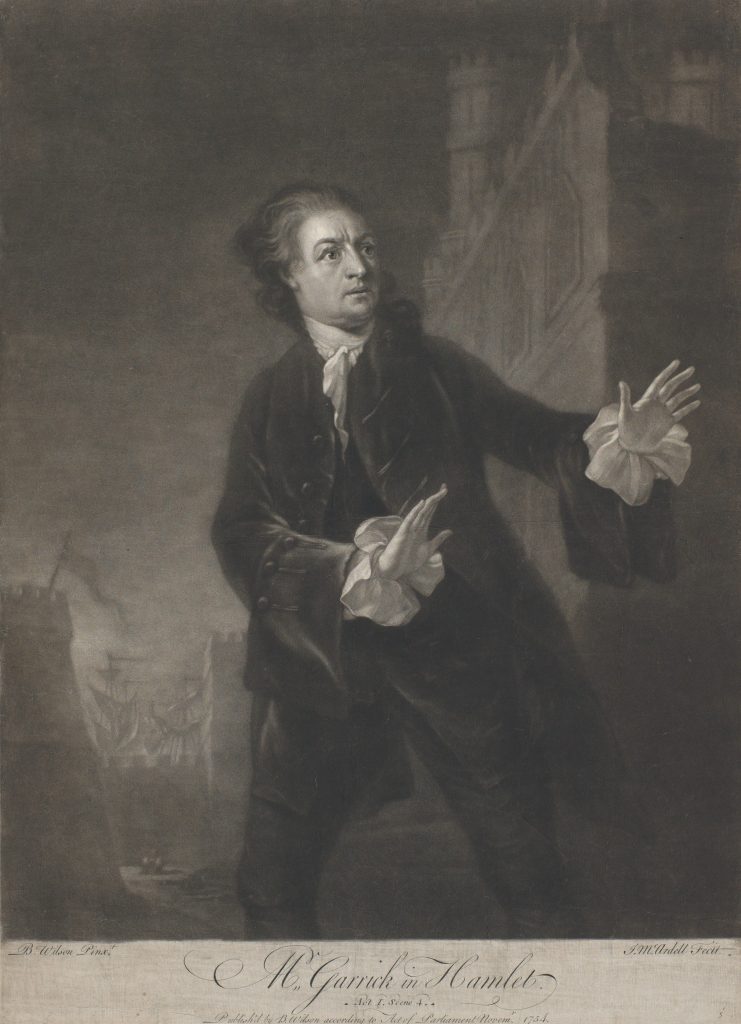
Hamlet draws much of its power from its exploration of the inner life of its main character, not only in the famous soliloquies where Hamlet considers the larger philosophical questions of the play, but also in conversation with other characters. Watching an actor cry real tears at imagined grief, he asks himself, “Am I a coward?”. Famously, he ponders whether “to be or not to be,” a speech incorrectly tied in the popular imagination to the most famous visual image of the play, a man speaking to a skull. Hamlet comes down on the side of life and duty, telling his friend Horatio at the end of the play, “There is special providence in the fall of a sparrow – – the readiness is all”.
Picture: Wikimedia Commons
Hamlet on stage
The role of Hamlet was composed for Richard Burbage, the leading man of Shakespeare’s company. Famous English actors to play the role include David Garrick, Laurence Olivier, and Kenneth Branagh. Women have also tackled the role, most famously the French actress Sarah Bernhardt in 1899.
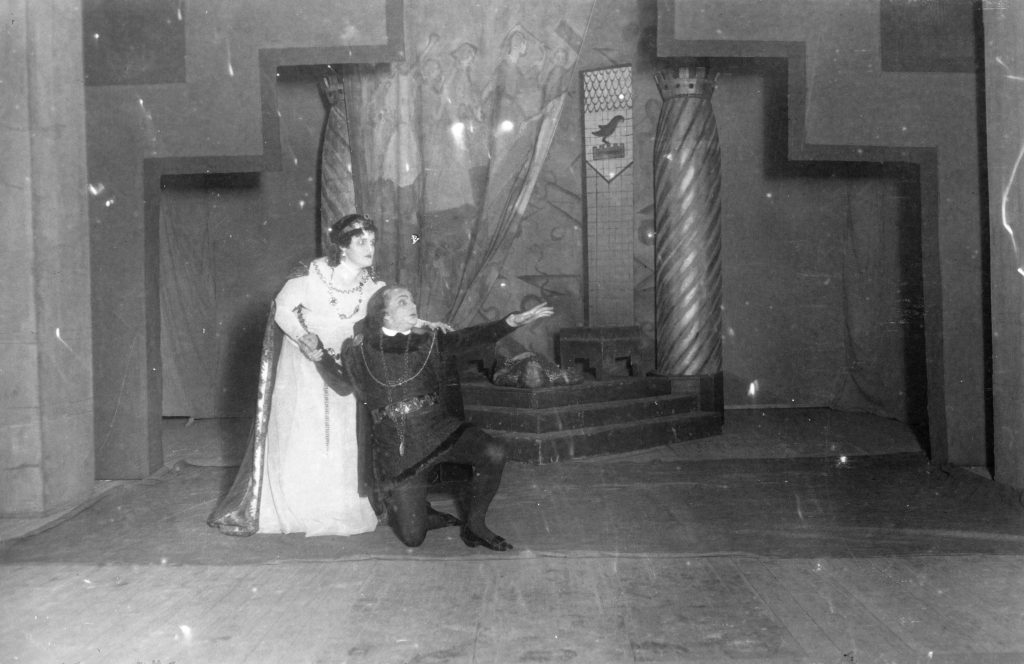
Hamlet has figured significantly in Finnish culture. It influenced Aleksis Kivi’s Kullervo (1859), the first tragedy written in Finnish. It was the first play translated by Paavo Cajander in the Finnish Literature Society’s complete works translation project (1879–1913) and has been re-translated more than any other Shakespeare play. Hamlet was first performed in Finnish in 1884 at the Finnish Theater (now the Finnish National Theater), with Axel Ahlberg and Niilo Salo alternating as Hamlet and Ida Aalberg as Ophelia. In 1913, Elli Tompuri became the first actress in the Nordic countries to play Hamlet. Many of the leading actors of their generation played Hamlet, including Kosti Elo and Wilho Ilmari, and more recently Leea Klemola (the second woman to play the role in Finland), Jani Volanen, Ville Sandqvist, Eero Aho, Tomi Alatalo, Jussi Nikkilä and Olavi Uusivirta. Aki Kaurismäki’s film Hamlet Goes Business [Hamlet liikemaailmassa] (1987), with Pirkka-Pekka Petelius as Hamlet, is a sardonic take on the Danish court reimagined as a Finnish lumber business.
Picture: Vapriikki Museum Centre archives
While there have been many films made of Hamlet, ballets are more rare, with the earliest from the late 18th century. Prominent choreographers include Bronislava Nijinska (1934), who danced the role herself, Robert Helpmann (1942), who also acted the role of Hamlet at the Old Vic in 1944, Konstantin Sergeyev (1970), John Neumeier (1976), Kenneth MacMillan (1988), Kim Brandstrup (1993), and Veronica Paeper (1994). More recently, Stephen Mills (2000) and Christopher Wheeldon (2007) choreographed Hamlet as well as Dada Masilo (2024), with Hamlet portrayed by both a dancer and an actor.
Text NELY KEINÄNEN
Hamlet at the Finnish National Ballet 2 October 2026 – 5 February 2027. Read more about the work and buy tickets.