The Symptoms of Silicon Valley
This has been a decade that materialised the consolidation of power and money in Silicon Valley. Over the past years, this cluster of tech corporations and high-profile CEOs has also found surprising – or in the end, unsurprising – proximity to the Trump administration. This alignment features as a particularly dark cloud on any projects of mental growth, spirituality, and Google’s early mantra “Don’t be evil” (or the later “Do the right thing”) that have characterised the tech world for a longer period.
One can hardly blame Apple or Steve Jobs for the sort of political events that have unfolded in the mid-2020s. Yet it is interesting to narrate a story of Jobs as part of the symptoms of how belief in tech and spirituality, creativity and design without politics became export articles just like the hardware and software.
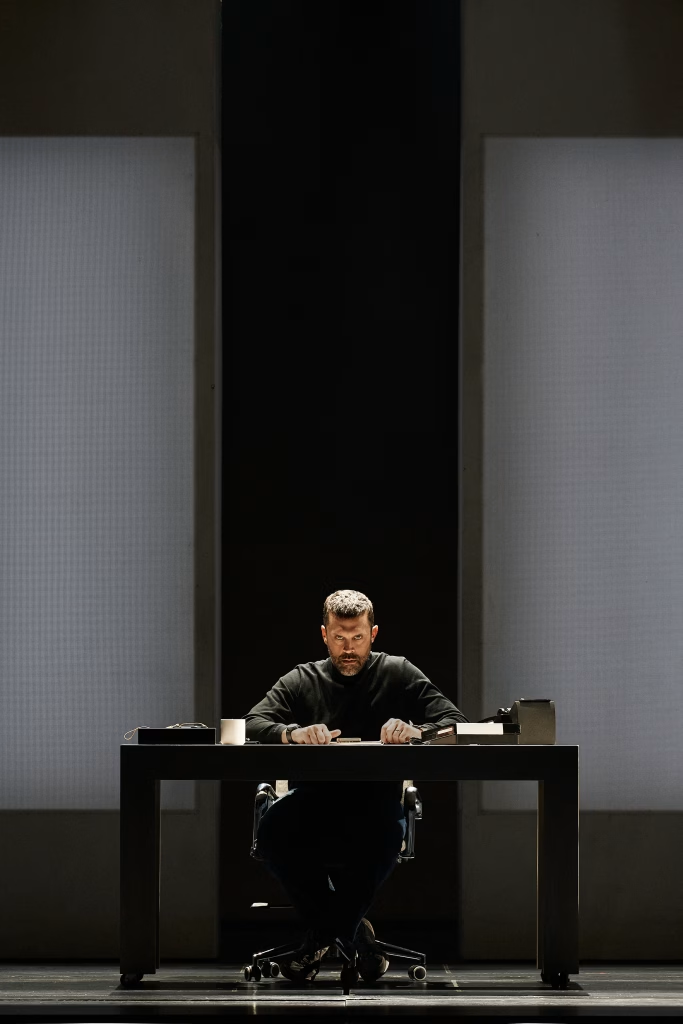
The public narrative from media to memoirs is well brought to the fore in The (R)evolution of Steve Jobs, which then also links to the hot debates in the current political climate. While the European political powers have realised the troubling implications of reliance on American technology, the issue also concerns a system of belief and mythology.
Spirituality would be a case in point and a rather benevolent one that also reminds us of the countercultural roots of many of the Silicon Valley entrepreneurs. The emergence of Silicon Valley was guided by an earlier tech visionary Buckminster Fuller, the populariser of planetary design for utopian high-tech futures.
More recently, though, darker kinds of religious and quasi-mythological beliefs have emerged through the public personas of Peter Thiel, Elon Musk, and others. Examples include accelerationism as well as transhumanism, which holds that technology can lift humans beyond their biological limitations such as aging or enable them to reach new levels of “intelligence.”
The flipside of all the spiritual-religious ideals circulating in and beyond Silicon Valley is, however, something inescapably material. While much of social media and pop journalism focuses on the individual creatives, the longer-lasting legacy is the mass culture of newly created gestures – hundreds of millions of people moving their fingers in a choreographed symphony of swiping. Someone’s spiritual awakening turns into carpal tunnel and smartphone thumb syndromes for the mass user base, a musculoskeletal twist that we did not see coming as evolution’s next step.
Another and likely more pressing legacy is the planetary scale environmental problem of electronic waste as the byproduct of the constant upgrade cycle. This planned obsolescence and the smartphone-body are likely to puzzle future archaeologists who go through the twisted thumbs and discarded layers of electronic trash in the future, trying to reconstruct the intensive 50-year period when this happened.
A reminder of these multiple legacies can be found at the Norman Foster-designed Apple “spaceship” headquarters in Cupertino, California, which sits adjacent to a landscape made toxic by semiconductor production from the 1960s to the 1990s. As these examples show, Jobs’s “one device” has several origin stories.
Reimagining Technology
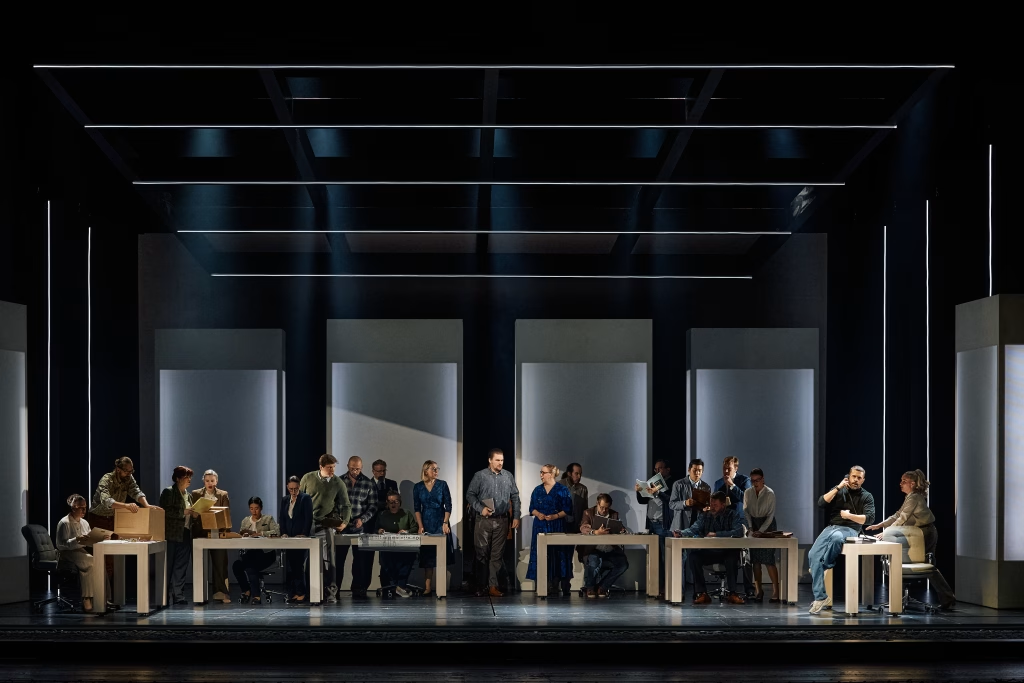
One can use The (R)evolution of Steve Jobs to place Apple in the larger historical emergence of creative tech companies. Apple was a frontrunner in using “innovation” as part of their brand values. Their 1984 Super Bowl TV ad for the new Mac – as in, the actual first Macintosh home computer – was directed by Ridley Scott and played a significant role in creating the mythology of the rebellious individual armed with computational tools of creativity.
This is a fitting example of the burgeoning marketing culture to convince the general population that computing is fun and creative, not just spreadsheets. Until then, it had still been largely seen as part of the military-industrial complex or linked to large sectors of administration such as banking. The slow development of today’s standard tools of digital culture and aesthetics was mostly done in research labs before their adaptation to the mass market. But the work of imagining a new kind of user took place already before Apple assumed control of the narrative.
A pithy line aptly sums up not just the early moment but also all that has happened afterwardrs: “The best way to predict the future is to invent it.” This quote did not emerge from Jobs but computer scientist Alan Kay, who led a design and development team at Palo Alto Xerox PARC.
Steve Jobs’s familiarity with the research and development (R&D) at this lab – just around the corner from Apple’s Cupertino location – is a telling example of this: the R&D lab is where the visual intuitive point-and-click interface for computing was developed alongside the first prototypes for hand-held tablet culture. Kay’s Dynabook (1972) was an early example: what is significant is that Kay already posed the question of how to design computing devices so that even kids could use them.
Today, anyone who has teenagers spending excessive time with handheld screen devices might curse that development. Inventions often come with a bundle of unintended futures.
Ensnared by ubiquitous devices
Opera from the Renaissance onward has relied on myth for allegorical celebration or critique of contemporary sociopolitical dynamics in which individuals are ensnared. Often these operatic individuals shape history in transformational ways. Contemporary opera at times directly draws on myth while also expanding what constitutes myth in times of changing media environments.
Today, opera has also turned to celebrity and popular culture for topics, including Marc-Anthony Turnage’s work on Anna Nicole Smith, as well as operas based on films or inspired by TV series such as Jake Heggie with Dead Man Walking, and Sung Jin Hong with Breaking Bad– Ozymandias. Such operas query the topic of myth itself, much as Steve Jobs provides a similar vehicle welding the American cult of success with that of high-tech entrepreneurial innovation and wealth creation.
Contemporary opera, like The (R)evolution of Steve Jobs, tends to examine individual trauma and psychological crises. In general, most contemporary opera relies on the trope of the individual as the key narrative driving device that overlooks the effects of the protagonist’s actions by concentrating on the protagonist themself. Economic, environmental, and geopolitical concerns rarely figure in contemporary works.
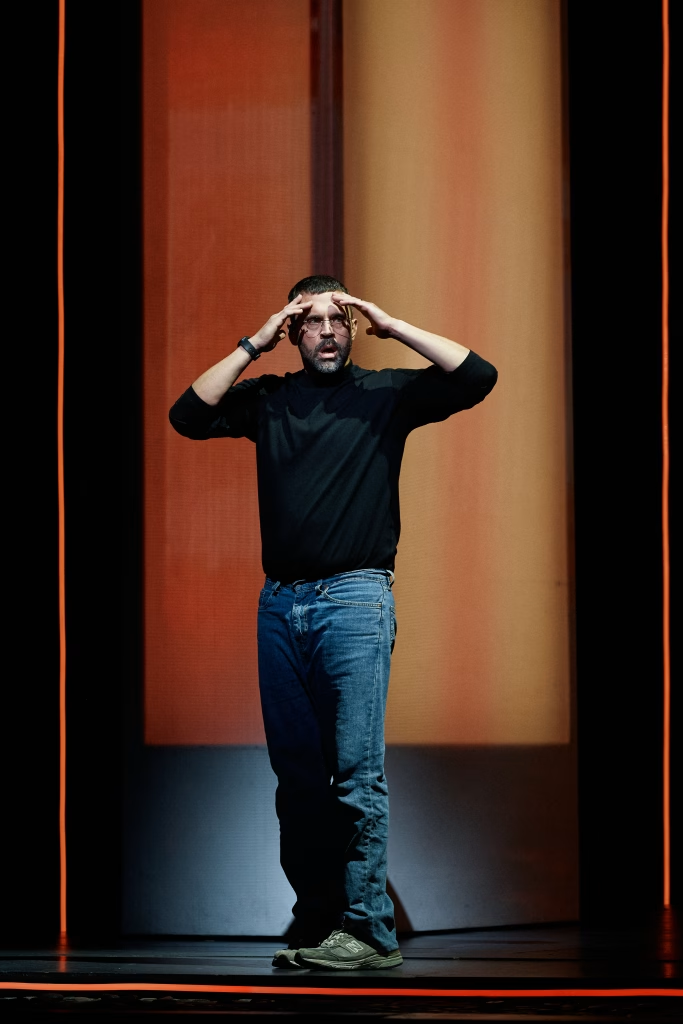
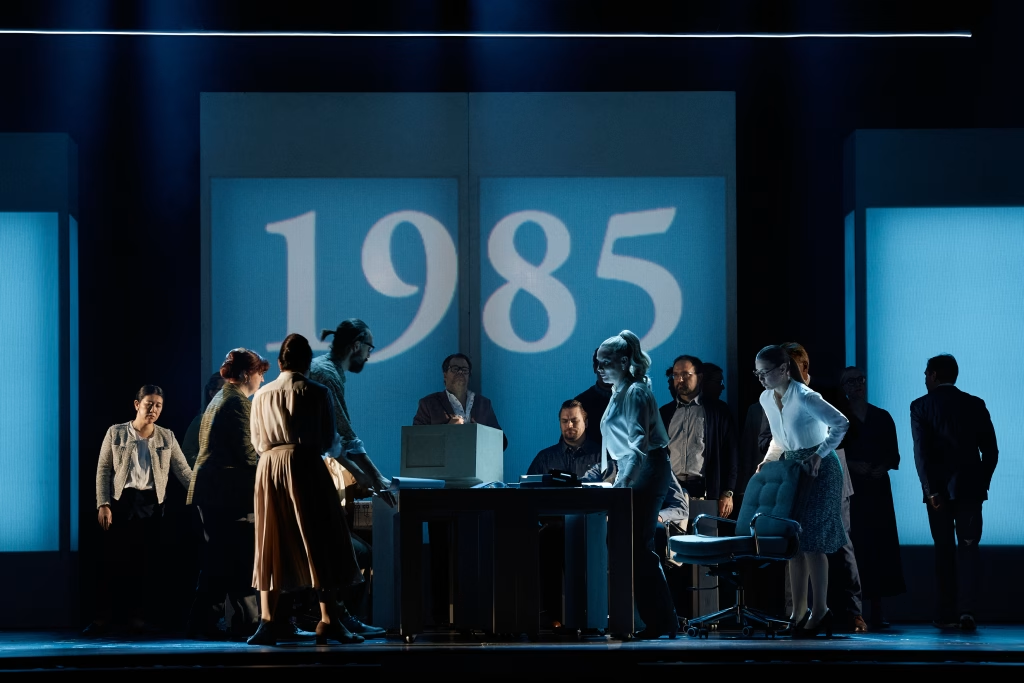
In The (R)evolution of Steve Jobs, wealth and power clash with spiritual doubt and complex psychological exploration. The individualised narrative of a revolutionary genius is a familiar one and often explores “the person behind the myth.” Narratives by their very nature are partial, arranging complex causal relationships in linear temporal developments. Campbell’s libretto breaks this temporal unity through a series of memories that invoke Jobs’ inner spiritual struggle and complex interpersonal relations, a glimpse into Jobs’s mind as a vehicle for existential questions.
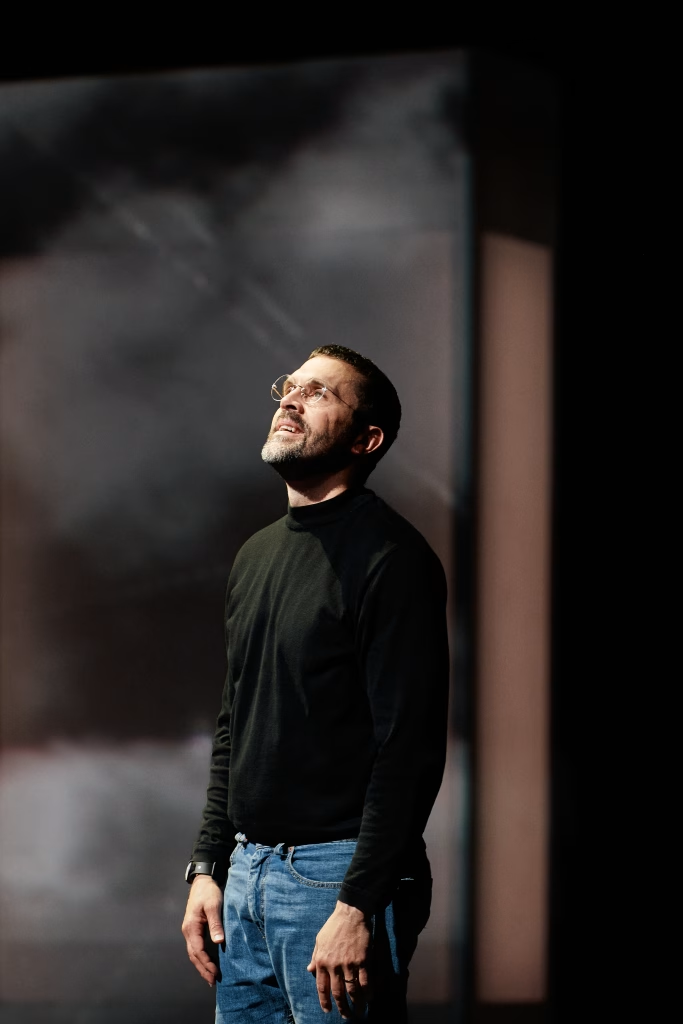
Perhaps a production note from Bates and Campbell best articulates the mythic in their interpretation of this individual: “Steve should never leave the stage; we are in his mind, and his memories – the world must come to him.” You can also interpret this as a manifestation of the persistence and ubiquity of computing – the device should never be switched off. We are in the device and witnessing how we have been placed there.
Text RYAN BISHOP, Professor of Global Art and Politics, University of Southampton & JUSSI PARIKKA, Professor of Digital Aesthetics and Culture, Aarhus University and University of Southampton
Photos by ILKKA SAASTAMOINEN