Light and Shade: Mark-Anthony Turnage and Lee Hall on the Making of Festen
It’s perhaps surprising that composer Mark-Anthony Turnage and librettist Lee Hall chose Thomas Vinterberg’s film Festen as the subject for a new opera. From its start, Festen announces itself as a Dogme 95 film. An avant-garde cinema movement founded by Vinterberg and Lars von Trier in 1995, Dogme was an extreme reaction against everything its ‘founding brothers’ believed to be wrong in contemporary cinema. It rejected technical excess in favour of pared-back storytelling, insisting that action take place in the here and now – no tales of long ago and far away. So how did this austere form of art lead to the most highly wrought and opulent art form there is: opera?
When Turnage first saw the film, it didn’t immediately suggest opera to him – although he confesses to always being on the hunt for operatic subjects, which are ‘really hard to find’. A friend suggested Vinterberg’s films, so he watched Festen again – and this time it seemed obvious. ‘How did I not think of this? Why hadn’t a Danish composer – or any composer – made this into an opera? The main action is in one room, you’ve got the party guests – a chorus – on stage all the time and then, of course, the speeches at the dinner are arias!’
Hall, too, was excited by this subject, immediately seeing the potential of opera to bring out the richness of the storytelling of Festen. ‘The film has a sort of heightened reality; although the Dogme style makes it look like it’s a documentary – with the hand-held camera thing going on – it’s actually hugely wrought as a piece of drama. From a screenwriting point of view, it’s a perfectly structured screenplay; everything happens at the right time, the minor characters all have their own little journeys – it’s a beautiful thing to take to another form, such as opera’.
Hall also saw how opera could expand the expressive range of Festen, amplifying, deepening and sometimes even contradicting the action. ‘You can add extra layers in opera, and you can play with the audience’s expectations of musical forms which provoke them or lull them into a false sense of security – and then shock them. Or you can be seeing something dreadful on stage but there’s something about what the orchestra is doing against that which makes it much richer’.
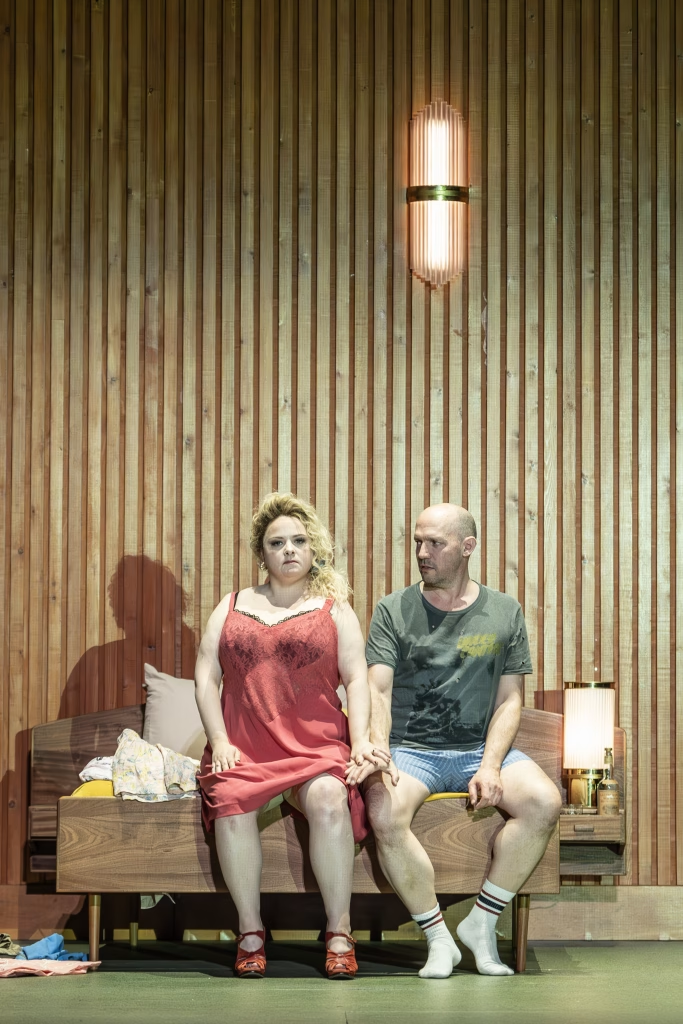
Turnage agrees, immediately mentioning the challenge he had setting to music the devastating speech Christian, the central character, makes, revealing his father’s sexual abuse of him and his twin sister Linda, who has recently died by suicide. ‘How the hell do you set that speech? Obviously, in the film, that moment is so shocking. But what I did was I made the music quite lyrical, and even a bit matter of fact. If I’d written music that was angst-filled against that speech it would have been hopeless’.
“You can add extra layers in opera, and you can play with the audience’s expectations of musical forms which provoke them or lull them into a false sense of security – and then shock them.”
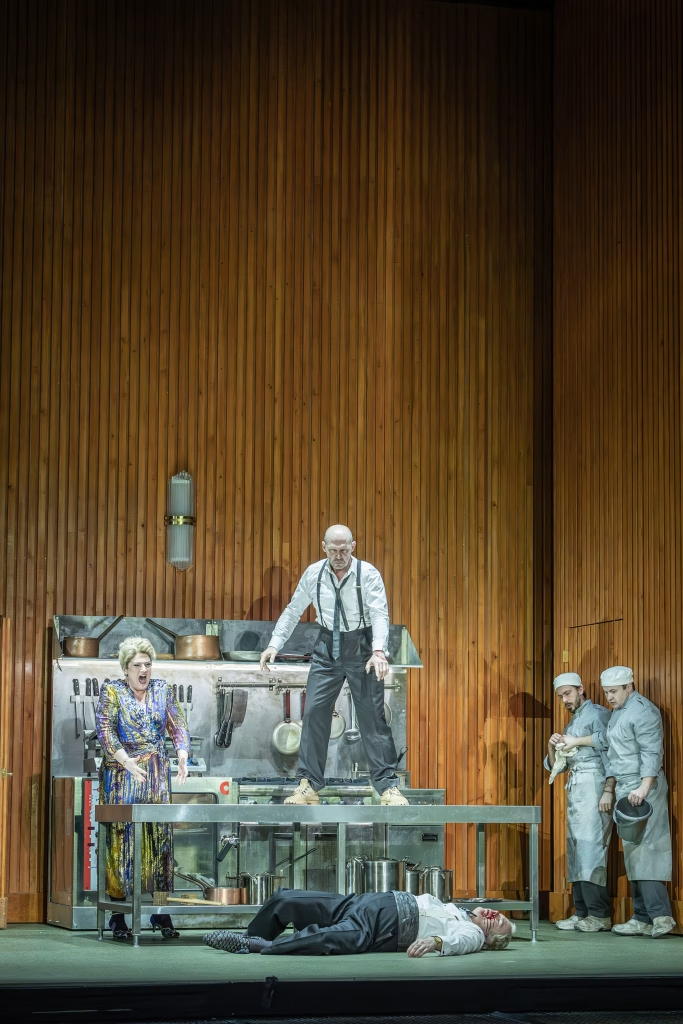
Hall was also excited by the trick that opera can play – more than any art form – of presenting contrasting actions and feelings simultaneously, in counterpoint with each other. ‘Lots of things happen simultaneously in the film and, of course, in opera, you can make that happen on stage and you can connect it all through the music’.
Turnage agrees. ‘In one scene,’ he says, ‘the Grandmother is singing a gentle folk-like song to the dinner guests, but there’s a vicious fight going on outside at the same time. You experience a real conflict between something lyrical, hopefully quite beautiful, and this nasty, violent undercurrent – and it’s all in the music’.
Does he assign certain musical profiles to each of the characters to identify them and deepen our experience of them? ‘Yes, you could perhaps call it a sort of leitmotif,’ says Turnage. ‘But it might be a tiny fragment of melody, or a harmonic background or instrumental colour; each character somehow has their own soundworld’.
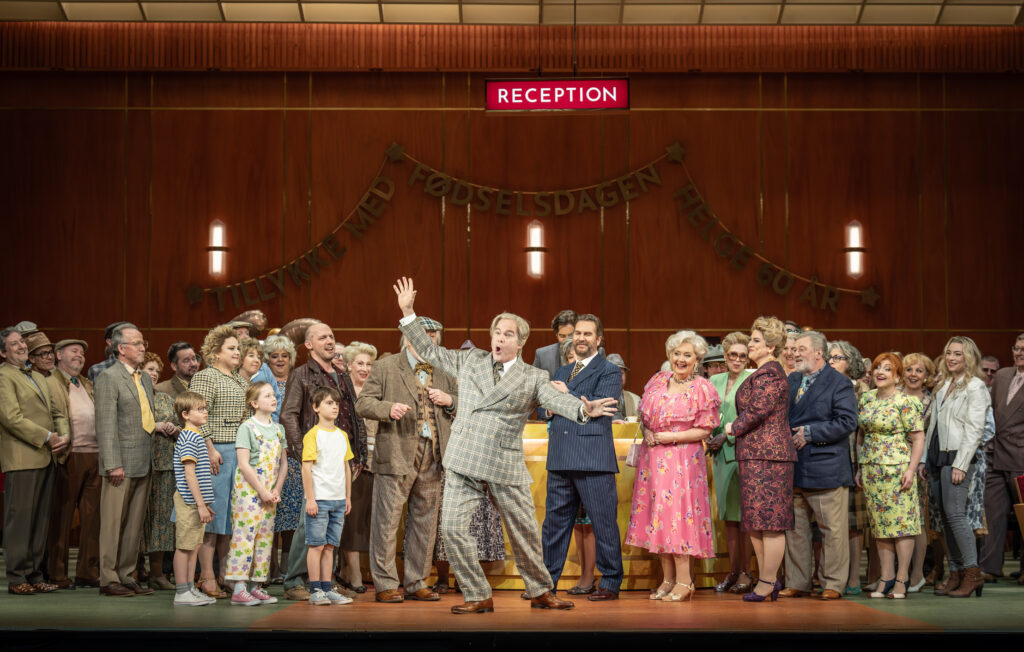
Both composer and librettist feel that the sheer number of performers – an operatic cast and chorus – adds a new dimension to Festen’s story. ‘With 80 people on stage’ says Hall, ‘the whole piece becomes about much more than these individuals and tragedies. It becomes an indictment of the collective act of denial.’ Turnage, too, recognises the power of both the sight and sound of a mass of people on stage. ‘It’s a bit like in Benjamin Britten’s Peter Grimes. The chorus plays such a big role. In Grimes they are an accusing mob; in Festen they collectively ignore and collude with what’s going on. It’s that aural thing – the sound of a mass of people – that you can do only in opera’.
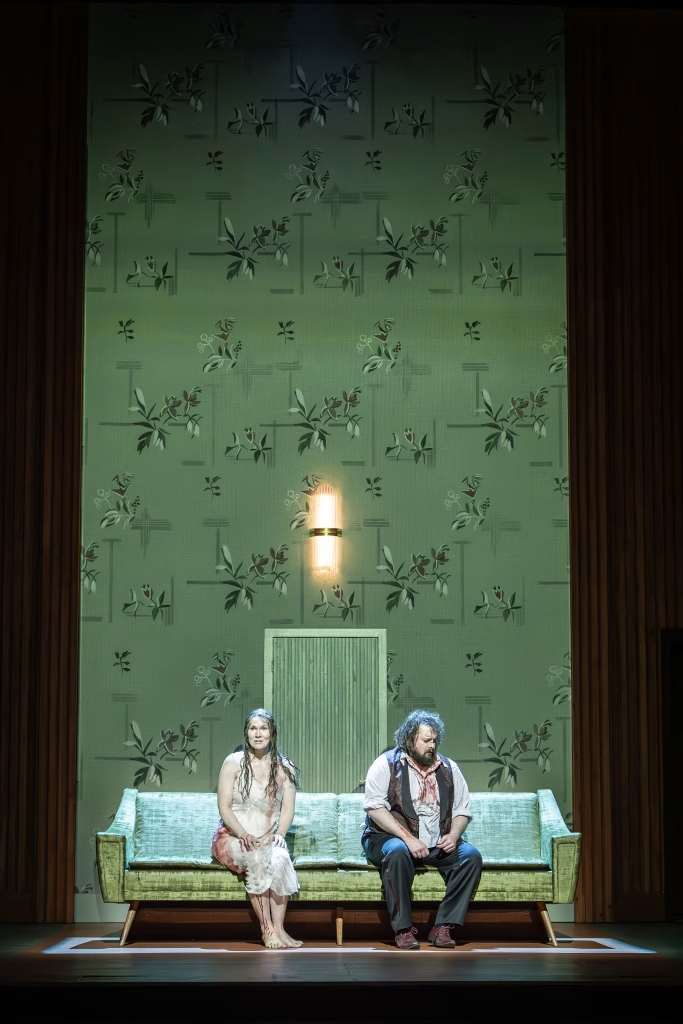
This emphasis on collective denial led both to their only significant deviation from the original film: they changed the ending. In the film, the abusive father Helge finally admits his guilt and takes himself, chastened, away from the group. In the opera there is no such reckoning, and we realise that the conspiracy of silence will continue. ‘The redemptive act at the end of the film seemed to be at odds with the primary material of the story, which is collusion and denial,’ says Hall. ‘We seem to be living in an age of denial, whether it’s about sexual abuse, climate change, or the political populism that’s taking hold around the world. Avoiding the resolution which happens at the end of the film means that the opera can be about something more than the things that happen in the story. Also, it was important that the Dad doesn’t get his redemption because it takes away from the victims – we want to keep the audience’s sympathies and focus with them’.
That decision to focus on the victim leads to another deviation from the film: Festen the opera gives a voice to
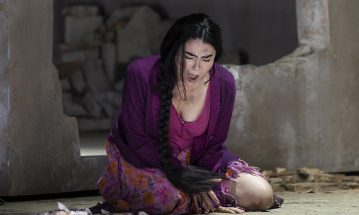
the ghost of Linda, the abused dead daughter, which the film does not. At the end of the opera, she has an aria in which she sings Julian of Norwich’s famous lines ‘and all shall be well, and all manner of things shall be well’. Turnage says that this aria, and the orchestral interlude that immediately follows it, form the emotional climax of the opera.
Turnage’s desire to collaborate with Hall was influenced largely by Hall’s understanding of music. The man who wrote Billy Elliott has a feel for a good vocal line. ‘Some writers think that writing an opera libretto is like writing a play,’ says Turnage. ‘Lee knows which words sound good when they’re sung – because he’s written musicals.’ Looking at Hall’s libretto for Festen, it’s immediately obvious that it’s a libretto and not a play – repetition, rhythm, counterpoint
of voices, choruses and ensembles – music seems to leap from the printed page which, says Turnage, ‘is really not always the case with a libretto – believe me!’
Another striking difference between the opera and film is that the libretto has a lightness about it, even humour. ‘Festen is a really, really dark comedy,’ says Hall, ‘and one of the reasons I wanted to work with Mark is that humour is an important part of his work. We didn’t even talk about the satirical, humorous aspect – we just understood. Great drama also has wit and satire and vinegar and grit – it’s not just one note. Look at Shakespeare! In Festen, the satire of people getting together and all the polite formalities is as important as the grim revelations. A good example is near the beginning, when we’ve made a whole chorus number out of the dinner guests speculating about exactly what kind of soup has just been served’.
“The language of the music is direct, I hope; and there’s lightness which counterpoints the heavy story.”
Turnage describes how the sound of his music contributes to the light, as well as the shade, in this emotionally complex piece. ‘The language of the music is direct, I hope; and there’s lightness which counterpoints the heavy story. And like in most of my music, the modality and the sound of jazz is always there somewhere’.
‘I love Mark’s discipline in the way he sets this story musically,’ says Hall. ‘It’s in the tradition of what’s great about opera – you can take very difficult things, and they can be aesthetically gorgeous and even at times fun to watch. It’s a rollercoaster and that’s what opera should be’. Adds Turnage, ‘People might know the film and think “that’s grim,” but I hope they will be surprised. This is not a grim 90 minutes in the theatre.’
Text GILLIAN MOORE
Gillian Moore is a music curator, writer and broadcaster. She is Artistic Associate at Southbank Centre, having previously been Director of Music there, and is Artistic Advisor to the Royal Scottish National Orchestra.
Photos MARC BRENNER / The Royal Ballet and Opera
Festen at the Finnish National Opera from March 27 to May 7, 2026. Read more about the opera.